
A Snow Room Instead of a Cool Pool: Why the Wealthy Want Minus Five in July
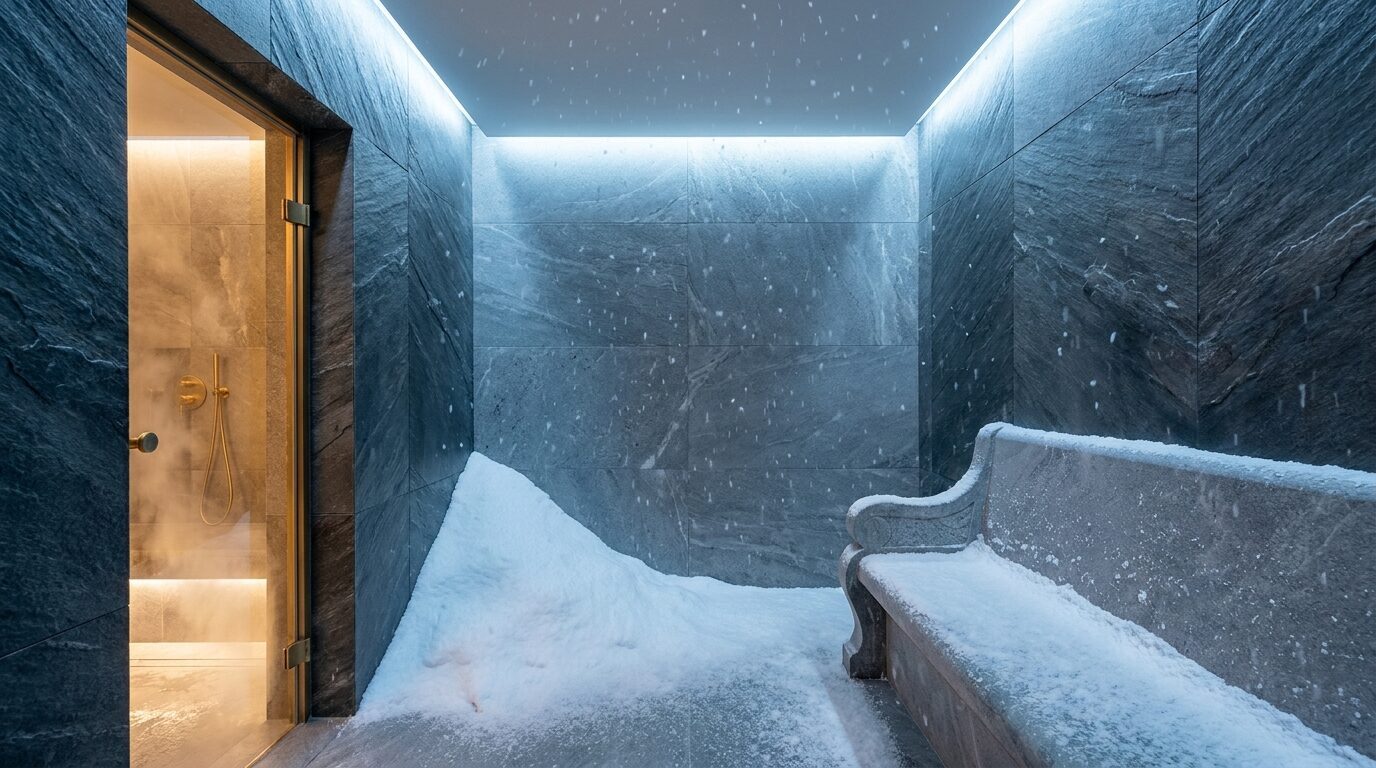
Last July, a client whose house we were finishing called me and said something I still remember: “Oleg, it’s twenty-nine degrees in my study, the air conditioning howls like a jet engine, and it does nothing. Build me a place that is genuinely cold.” I joked about a root cellar. A month later we were calculating refrigeration loads for a room where it snows. Real snow. In the basement of a mansion outside Moscow. That is how the snow room at home entered our practice — a spa format that, five years ago, was discussed seriously only by owners of alpine ski hotels.
This summer the subject stopped being exotic altogether: Architectural Digest writes about snow rooms as the place where the wealthy hide out during heatwaves. And this is that rare case where behind the fashionable image stands clear physiology and genuinely serious engineering.
What a snow room is — and why it is not a walk-in freezer
A snow room is a space of four to six square metres in which a climate system maintains sub-zero temperatures all year round and generates real, powder-soft snow. Flagship systems — Klafs with its Snow Paradise, for instance — hold the room at a steady minus ten. Industrial snow systems for spas operate down to minus eighteen and below.
Almost everyone’s first reaction is the same: “That’s a freezer — why would I want one in my house?” No, not a freezer. The difference is the snow. Dry frosty air and soft snow you can scoop into your palms and rub over your shoulders are perceived by the body entirely differently from an ice plunge. The cold works gradually, without shock — which is exactly why even people who would never lower themselves into an ice bath use a snow room happily.
Why the wealthy want minus five in July: the physiology of contrast
A snow room only reveals its meaning when paired with heat. The classic contrast-therapy protocol is twelve to twenty minutes in a sauna or hammam, then one to three minutes in the cold. Blood vessels first dilate, then sharply constrict — training the cardiovascular system, reducing muscle inflammation, accelerating recovery. Athletes pay clinics for this procedure. The owner of a house with a snow room gets it every evening, in a bathrobe, thirty steps from the bedroom.
But here is where it gets interesting. In summer the snow room also works on its own — as a refuge. When it is thirty-four outside and the asphalt is melting, three minutes at minus ten reset the body better than any air conditioning. Air conditioning cools the air. Snow cools you.
Where the snow room lives in the house
The right answer: in the wellness zone, next to the source of heat. In our projects the spa floor forms a route: hammam or sauna, then experience showers, a plunge pool or swimming pool, a relaxation area. The snow room takes its place on that route as the cold point — between the steam and the rest. Look at how the spa zone is arranged in our Terme project — the logic of moving from hot to cold and back is built into the plan itself. And in Notturno an entire lower level is given over to the pool, sauna and hammam — precisely the configuration in which a snow room comes fully into its own.
The basement is not the only option, but it is the most honest one: it is easiest there to conceal the refrigeration plant, route the services, and avoid arguing with natural light, which snow does not need.
Engineering: what hides behind minus ten
Here is where most people go wrong. A snow room is not “install a more powerful air conditioner”. It is a separate engineering system with requirements of its own:
The refrigeration circuit. A remote unit that has to live somewhere and reject its heat somewhere — its position is set in the building services design, not improvised after the fact.
Thermal and vapour insulation. A permanently sub-zero room inside a warm house means a dew point along the entire envelope. A mistake in the vapour barrier means ice in the floor slab and a wet wall in the neighbouring room within a season.
Snow generation and water treatment. Snow is made from water — you need supply, drainage and nozzle maintenance.
Power and controls. The plant runs around the clock and ties into the home automation system.
Every one of these points is solvable — but only at design stage. We always design the spa zone together with the house’s engineering systems, because rebuilding refrigeration inside a finished interior is a dubious and expensive pleasure.
Typical mistakes: how a snow room becomes a storage closet
Over several years we have seen plenty of other people’s installations. Three mistakes repeat constantly.
Mistake one — a room without a scenario. A snow room installed “because we saw one in a hotel”, in a house with no sauna and no hammam. Cold without heat is a two-week attraction. Then the door closes forever.
Mistake two — economising on volume. A two-by-one-and-a-half-metre cabin where you can only stand is not a snow room; it is that very freezer. You need a bench, room to rub snow over your skin, a ceiling height you can breathe under.
Mistake three — the interior as an afterthought. Plastic panels in a room at this price point are a sorry sight. Snow deserves stone. Large-format porcelain, natural slate, lighting that turns a snowdrift into sculpture. The cold room can be the most beautiful room in the house — precisely because there is nothing superfluous in it.
Our approach: snow as part of the bigger picture
At the studio we do not sell snow rooms — we design houses in which they have a place. The difference is fundamental. First, the family’s way of living: who takes the steam, who swims, who recovers after sport. Then the spa route, the sections, the engineering. And only then the specific equipment manufacturer, whether Klafs or a custom-built system. The procurement — from stone slabs to snow nozzles — we handle ourselves through our turnkey interior procurement, so that nothing is lost between the design and the result.
A client once asked me: “Isn’t it too much — snow inside the house?” I answered with a question: how many times last summer did you regret that you cannot fly out of the Moscow heat into the mountains for an hour? He paused. A snow room is exactly that hour in the mountains. Only the lift goes down to the basement, not up the slope.
If you are designing a house and thinking about a real spa zone — come to the studio and we will show you, on completed projects, how heat and cold live together under one roof. Or simply write to us, and we will discuss your future route from the hammam to the snowdrift.

Author

Next step
Discuss your project
An hour at the studio with Oleg Reznikov: your site, your brief and relevant studio projects.