
Pool inside or outside: a choice made once
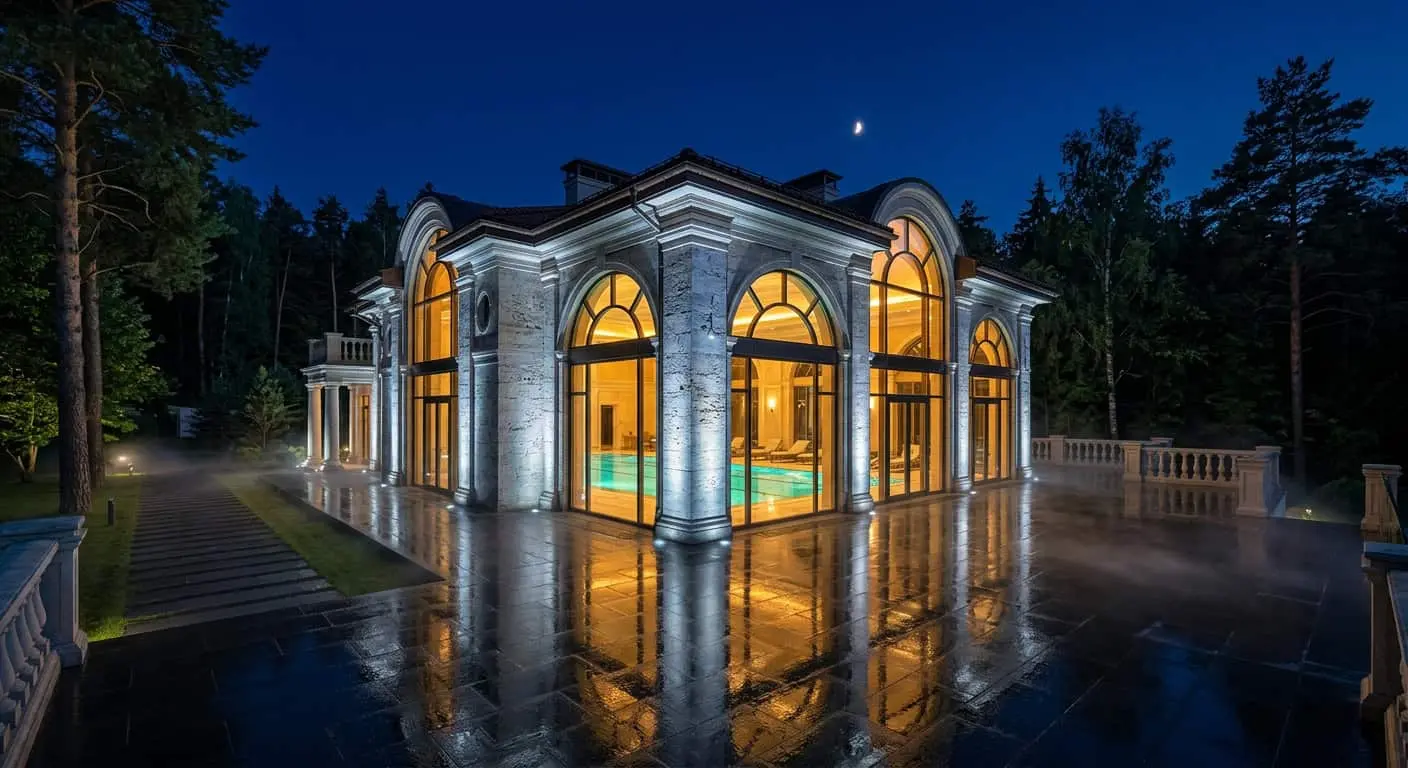
Five years ago we delivered two estates almost simultaneously. Different families, different plots, but water zone budget — comparable, within 15% of each other. In one project we built a covered pool pavilion with panoramic glazing. In the other — open infinity on a terrace overlooking pine forest. Both clients were confident in their choice then. Today, five years into operation, I know one would repeat unchanged, and the other would change it if he could go back. And that’s why this conversation matters more than it seems: a pool on an estate as architectural element determines not just leisure scenario, but the house’s geometry, the plot logic, the structure of expenses for twenty years ahead.
Architecture changes faster than we think, but water in a home is a slow story. You can’t replay it in three years like a kitchen island or living room finishing. A pool is an engineering structure that everything else builds around: bearing structures, ventilation, landscape, even the orientation of main windows. That’s why “inside or outside” is one of the few decisions made truly once.
In this article I’ll tell what practice showed on two specific projects, where we miscalculated, and how today we guide clients through this choice.
Two objects, two solutions: brief history
Property A. Covered pavilion. Estate on Novaya Riga, 2,800m². Family with three kids, eldest now 14. Pool 12×5 meters, separate volume connected to main house by warm corridor. Panoramic glazing southwest; lifting glass sections turn pavilion into semi-open terrace in summer. Agrob Buchtal tile 60×120, ceiling thermally modified wood, Calorex dehumidifying system 80L/day capacity.
Property B. Open infinity. Estate in the Moscow region, sloped plot with 6-meter elevation shift. Basin 14×4 meters, overflow edge facing forest. Finish natural travertine, water heated via heat pump; winter conservation and thermal cover.
Water zone budgets both cases — roughly 18–22 million rubles at build time. Then differences emerge, ones few think about at sketch stage.
Why pool on an estate is an architectural element, not an option
Here’s where most miss the mark. Client says: “We want a pool.” In their mind — Pinterest picture: azure water, sunset view, wine glass. That’s wish for lifestyle. A pool is 40–80 tons of water, constant 55–65% humidity, heat-loss loop, separate boiler room, water-treatment system the size of a small room.
When we say “pool as architectural element,” we mean something simple: it doesn’t add to the house, it structures it. A covered pool demands either separate volume with its own envelope or major overhaul of main house engineering. Open pool dictates plot geometry, terrace placement, even the plinth height.
If the decision comes at “house is designed, now add a pool” stage — it will be expensive and compromise always. Always.
Property A after five years: what covered pavilion showed
The family swims year-round. Kids weekday evenings, parents early mornings. November through March it’s essentially the family’s second gathering point — unexpected even to them.
But here’s the interesting part. Operating costs ran 30% higher than forecast. The main line item isn’t water or chemicals — it’s electricity for dehumidification and winter air heating. About 45–55 thousand rubles monthly in heating season. We’d projected 30–35.
Second nuance — maintenance. After three years, seals needed replacing on the lifting glass sections. Wet environment with temperature swings — not every European hinge survives. Now we immediately specify premium-tier hardware in such projects, though it adds 15% to glazing cost.
Would the client repeat? Yes. He said exactly: “It’s the only thing keeping the family together in winter.” For him the pool paid for itself not as luxury but as home social architecture.
Property B after five years: honest talk about infinity
Open pool — different life scenario. Without heating, swim season in the Moscow region is June-August. With heat pump it stretches to May-September, but September is already cool exiting the water. Real use — 4–5 months annually.
The client — entrepreneur, travels constantly. Pool runs in “guests and weekends” mode. Average use over five years — 35–40 times per season. Each swim, budgeting capital and operating costs, costs like a restaurant dinner.
But that’s not the whole truth. Open infinity is visual architecture. Even thermally covered, it mirrors landscape. From living room, bedroom, terrace — always in frame. It works as an element that creates atmosphere even when nobody swims.
What would he change? Says: “I’d make it smaller — 10×3.5 instead of 14×4. And add heated jacuzzi separately for year-round use.” Infinity proved oversized in area and undersized in seasonality.
Typical mistakes we see constantly
Mistake one: pool inside the main house, not as separate volume. Classic 2000s thinking. Seemed efficient and prestigious. In practice — eternal humidity wars, chlorine smell in corridors, metal corrosion in adjacent rooms. Today we almost always make pavilion a separate object, linked by warm corridor.
Mistake two: economy on water treatment. Chinese filters instead of German, consumer-level automation, no UV sterilization. In two years — water quality issues; in four years — equipment replacement. Start difference — 800k. Ten-year difference — minus 2.5M.
Mistake three: open pool without understanding orientation. Basin faces north; house shadow covers water after 3pm; cold wind corridor from the site’s cold side. Beautiful concept, nobody uses it.
Mistake four: infinity where there’s no view. Overflow edge costs 40% more than skimmer. Makes sense only if beyond the edge lies real landscape: forest, water body, elevation. Infinity toward neighbor’s fence is architectural nonsense.
How we guide clients through this choice today
First thing — we don’t sketch the pool. We count usage hours. Questions: who swims, frequency, which months, solo or with guests, morning or evening, kids what age in five years. Answers reveal: do you need year-round or seasonal scenario.
Year-round demand — covered pavilion. Always separate volume. Always transformable envelope: must open in summer, else it turns into an artificial aquatic park. Pool basin size — by real swimmers in family, not Pinterest.
Seasonal demand — open pool. Here landscape matters more than water. We design it as part of topography: nestle in relief, use natural materials — travertine, granite, textured concrete. And always add jacuzzi or spa separately — closes off-season without requiring a covered pavilion.
Third path — hybrid. Small covered pool for laps (8×3, purely functional, one lane) plus open basin or spa for visual scenario. Costs 20–25% more but covers both scenarios without compromise. Often optimal for large estates 1,500m² plus.
What we’d choose again
Honestly — both solutions were right for those specific families. Mistakes lay in details: sizes, equipment, some materials. The principle choice “inside or outside” both made correctly because it grew from lifestyle, not from other people’s pictures.
We’re at the threshold of an era when country homes stop being success decoration and start being infrastructure for long living. A pool in this logic isn’t about status. It’s about whether your home stays alive in ten years when kids grow and guests come less. A covered pavilion keeps family together in winter. Open infinity creates atmosphere that makes you want to return. Both work — if chosen consciously, not by habit.
If you’re deciding now — come see both projects. With owner permission, we sometimes arrange such visits. One hour in a real pavilion during winter teaches more than ten hours of presentations.

Author
Next step
Discuss your project
An hour at the studio with Oleg Reznikov: your site, your brief and relevant studio projects.