
Open Book or Fixed Price: Paying for a 300-Million Mansion
Two contracts for the same house lay on the meeting table. The difference between them was thirty million roubles and the entire future life of the project. The first said “firm contract price”. The second offered an open book cost estimate: building the mansion against the contractor’s actual invoices, plus his fee. The client — a man who has spent twenty years running a business on numbers — looked at me and asked: “Where does each of these cheat me?”
A fair question. The honest answer: both do. Just differently, and at different moments.
Two payment models: what the client is really buying
On paper it looks simple. Under a firm price, the contractor names a final figure for a defined scope and takes the risk of deviation. Under cost-plus, the client sees the real supplier invoices and pays the contractor a separate fee — either a fixed sum or a percentage of the site’s turnover.
But a client is not buying a number in a contract. He is buying a distribution of risk. And this is where it gets interesting.
A firm price is insurance you pay for up front. The contractor has to price in everything he does not yet know: currency swings on imported equipment, errors in the drawings, winter premiums, downtime caused by ground conditions. If he is a professional, that insurance is honestly called a contingency and runs at 10–20% above his calculated cost. If he is an optimist, there is no contingency — and you will find out in month seven.
Cost-plus is giving up that insurance in exchange for transparency. You see every invoice, but every price increase is also yours.
What Russian law says: “firm” does not mean “unchangeable”
Here clients get their first surprise. Russian law treats these models far more harshly than builders do across a negotiating table.
Article 709 of the Civil Code splits the price of work into approximate and firm — and states plainly that where the contract says nothing else, the price is deemed firm. In other words, a contract that simply carries a number without the word “approximate” will be read by a court as fixed. Plenty of contractors do not know this and sign up to something they cannot deliver.
Clause 6 of the same article: the contractor may not demand an increase of a firm price, and the client may not demand its reduction. That sounds like armour for the client. But then comes the proviso the whole game is played for: where the cost of materials and equipment rises substantially and could not have been foreseen at signing, the contractor may demand an increase — and if the client refuses, termination of the contract.
Read those last two words again. Termination. In month six. With your excavation open to the sky.
Then there is Article 744, on changes to the technical documentation. The client may make changes provided the additional works they trigger do not exceed ten per cent of the total cost stated in the estimate and do not alter the character of the works. Anything beyond that requires an agreed supplementary estimate. And symmetrically: the contractor may demand a revision of the estimate if, for reasons beyond his control, the cost has exceeded it by at least ten per cent.
Ten per cent of a 300-million budget is thirty million. Precisely the sum that started this conversation.
And there is a third provision almost nobody remembers — Article 710, on the contractor’s savings. By default, whatever he saves he keeps. But the law expressly allows the parties to agree how savings are shared. One paragraph that flips the contractor’s incentives on their head. It is almost never written in, because nobody asks for it.
Where the margin hides in a fixed price
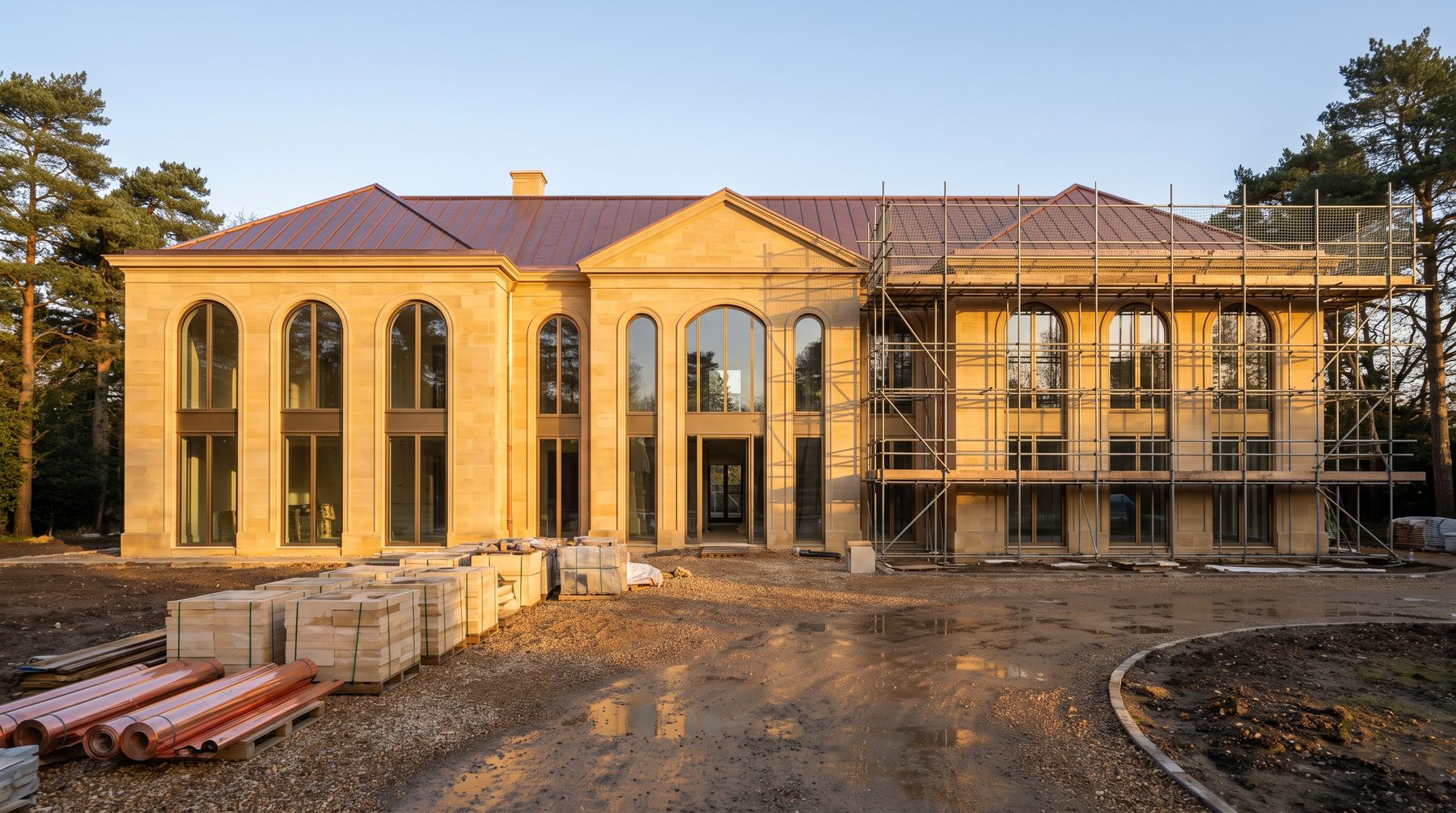
We had a project outside Moscow: 1,100 square metres, limestone facade, copper roof. The client chose a fixed price on principle — “so I can sleep at night”. The winning contractor came in eight per cent below the two rivals. The client decided he had won the tender.
What he had won was nine months of correspondence.
The margin in a fixed price does not hide in the mark-up. It hides in the scope. The contract says “plastering of walls” — but not which plaster, by what method, to what geometry of corners, within what tolerance. From there the arithmetic is simple: everything not written down is additional work. And every additional work is priced at new rates, with no tender, because you cannot bring in a competitor halfway through a build.
This is where most clients go wrong: they negotiate the bottom-line figure when they should be negotiating the bill of quantities. A firm price is only as firm as the design it is attached to. At concept stage a firm price does not exist — what exists is a handsome number the contractor reserves the right to revisit.
The second trap is materials “or equivalent”. The specification names a particular lighting brand; the contract says “or equivalent”. An equivalent will always be found. It is always cheaper. You will not see the difference in the paperwork — you will see it in the living room every evening.
Which is exactly why the pre-construction stage — working drawings, specifications, a tender run on identical terms — earns its fee even when it feels like a place to save time.
Where the margin hides in an open book estimate
Now, honestly, about the second model — the one I recommend more often.
In international practice, a cost-plus builder’s fee on private residences typically runs at 10–20% of the cost of works, with the wider market stretching the range from 5 to 25%. For comparison: in Russian practice, the main contractor’s fee for organising and servicing subcontracted work is usually in the order of 5–10% of the subcontractor’s volume. Comparable numbers. The difference is that with open books you can see the fee, while under a fixed price it is simply dissolved into the total.
But there is a built-in conflict of interest here, and I prefer to say it out loud. If the fee is a percentage of cost, the contractor earns more when the build costs more. No malice is required: it is enough to push a supplier slightly less hard, to take a rework slightly more calmly, to order slightly more spare tile.
Three devices cure this, and all three belong in the contract.
First — a fixed fee rather than a percentage. Twenty-five million for managing the build, whether you end up spending 280 or 340. The contractor stops profiting from escalation.
Second — a ceiling. Internationally this is the GMP, the guaranteed maximum price: open books plus an upper limit above which the overrun is the contractor’s problem. Inside the ceiling sits a separate contingency line, and spending that line is approved, not written off in silence.
Third — shared savings. That same Article 710: if the job lands below the ceiling, the difference is split, say, fifty-fifty. For the first time the contractor has a measurable financial reason to negotiate with suppliers the way he negotiates for himself.
This construction — open books with a ceiling and shared savings — delivers a better outcome over the length of a project than either pure model. It is also what Western banks insist on when they finance expensive private construction: open-book draws, a budget limit, a mandatory contingency reserve.
Four client mistakes on a 300-million budget
Mistake one: believing a fixed price protects you from inflation. It does not — it prepays it. Industry forecasts put the growth of construction services at 5–8% a year through 2025–2027, and individual positions jump harder: in autumn 2025 the monthly rise in building material prices reached around ten per cent. A contractor quoting a firm price for a three-year build has to carry all of that. If he has not, see clause 6 of Article 709 and the conversation about termination.
Mistake two: comparing two proposals by the bottom line. They must be compared line by line, against an identical bill of quantities. A bid that reads “electrics — 18 million” on one line and a forty-page bid with socket counts, cable metreage and switchgear brands are not comparable documents. A sound contractor’s commercial estimate is accurate to roughly 5–7%; anything promising more precision at concept stage is marketing.
Mistake three: economising on independent control. An open book estimate without someone verifying invoices and physical quantities on site is simply your wallet with someone else’s access. That is why we treat construction management and design supervision not as a service but as part of the project’s financial structure: the fee is usually less than one month of unnoticed overspend.
Mistake four: signing without a payment schedule tied to results. Not “60% advance”, but money against completed stages: foundation and shell, thermal envelope, services, finishes. A site where the contractor is always a month richer than he is built loses control under any pricing model.
Our approach: where a firm price fits, and where open books do
After twenty years I no longer believe in pure models. On one residence near Nikolina Gora we split the budget: shell, roof and engineering on a firm price, because the design was fully resolved and the risk there is small; finishes and furnishing on open books with a ceiling, because the client told us honestly that she would keep changing stone and fabrics. And so she did — the stone changed twice. Under a fixed price that would have cost two conflicts and one variation order priced “as negotiated”. Under open books it cost exactly what the new stone cost.
The rule we give clients sounds dull but holds: a firm price where the design is final; open books where decisions will still move. Structure and engineering usually belong to the first category. Interiors, furniture, lighting and landscape almost always belong to the second, however firmly the client insists at the start that everything is decided. Look at any of our completed projects — the residence at Millenium Park, for instance: the material palette you see there differs from the original specification by some fifteen per cent. That is the normal course of a living project, not a planning failure. The only question is which contract lets it happen without a war.
What to check in the estimate and the contract before you sign
The short list I usually dictate to a client on the spot.
One — state explicitly whether the price is firm or approximate. Silence is read by the law in favour of whichever party prepared better for court.
Two — attach the bill of quantities and the specification as an integral part of the contract. Either strike out the words “or equivalent”, or give the client a written right of approval over any substitution.
Three — write in the change procedure: what counts as additional work, who values it and how, within what deadline. The ten per cent threshold in Article 744 is your legal anchor, but describe the process in more detail than the law does.
Four — under an open book model, fix the form of the fee, the client’s right to see primary supplier documents, the budget ceiling, and the fate of any savings.
Five — agree how the parties part company. The most expensive clause in any contract is the one describing the exit. Check that on termination you keep the design, the as-built documentation and the materials you have already paid for.
And a final, non-legal point. A payment model will not turn a bad contractor into a good one. It only determines the form in which you learn the truth about him — gradually and in small portions, as with open books, or all at once in month nine, as with a fixed price. Do not choose the contract. Choose the people, and then write the contract so that even with good people you never have to test the friendship.
If two proposals are sitting on your desk right now and you cannot see what separates them beyond the figure at the bottom, send them to us. We will go through them line by line and show you where the risk is buried. That is the conversation that costs far less before the signature than after it.

Author



Next step
Discuss your project
An hour at the studio with Oleg Reznikov: your site, your brief and relevant studio projects.